
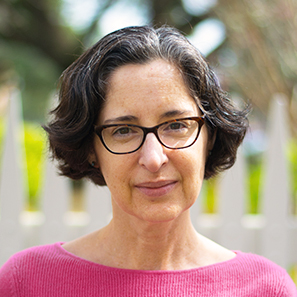
Deborah Weiss
Professor
Director of Undergraduate Studies
- dweiss@ua.edu
- (205) 348-5693
- 103A English Building
- Curriculum Vitae
Education
- PhD, English, University of Chicago, 2004
- BA, English and History, Washington University, 1988
Research Areas
- Restoration and 18th-Century Literature
- 19th-Century British Literature
Bio
I specialize in literature of the long eighteenth century and the history of the British novel. I received my BA summa cum laude from Washington University in St. Louis with a double major in English and History and my PhD in English Literature from the University of Chicago. In my research, I’m primarily focused on the engagements of eighteenth-century women novelists with the social, educational, and economic ideas of the Enlightenment and early Romantic period. My latest book is entitled Mad Women of Romanticism: Injured Minds, Ruined Lives. In it, I examine how five early Romantic-period women writers used female madness to critique patriarchal structures of control and to revise misogynistic medical and sentimental models that blamed inherent female weakness and the aberrant female body for women’s mental and emotional afflictions. I regularly teach the British Literature I large-lecture survey, the 300-level survey on English Literature in the Enlightenment, and 400-level and graduate classes on a variety of topics. Some of my recent upper-level undergraduate and graduate courses have been on the British Gothic novel, Jane Austen, children’s literature in the Enlightenment, and topics connected to sexuality, gender, and female madness in eighteenth-century and early nineteenth-century novels.
Selected Publications
Monographs
Women and Madness in the Early Romantic Novel: Injured Minds, Ruined Lives
Manchester University Press, November 2024
The Female Philosopher and her Afterlives: Mary Wollstonecraft, the British Novel, and the Transformations of Feminism, 1796-1811, Palgrave, 2017
Journal Articles
“Domestic Intelligence: Leonora and National Security,” European Romantic Review, 32.1 (Winter 2021): 1-21, https://doi.org/10.1080/10509585.2020.1865164
“Maria Edgeworth’s Infant Economics: Capitalist Culture, Goodwill Networks, and ‘Lazy Lawrence,’” The Journal for Eighteenth-Century Studies, 37: 3 (Fall 2014): 395-408,
https://doi-org.libdata.lib.ua.edu/10.1111/1754-0208.12129
“Sense and Sensibility: Uncertain Knowledge and the Ethics of Everyday Life,” Studies in Romanticism, 52:2 (Summer 2013): 253-273, https://doi.org/10.1353/srm.2013.0017
“The Form of Social Class and the Reformation of Ireland: Edgeworth’s Ennui,” Studies in the Novel, 45:1 (Spring 2013): 1-19, https://doi.org/doi:10.1353/sdn.2013.0001
“Sarah Scott’s ‘Attick School’: Moral Philosophy and Ethical Agency in Millenium Hall,” Eighteenth-Century Fiction, 24:3 (Spring 2012): 459-486, https://doi.org/10.3138/ecf.24.3.459
“The Extraordinary Ordinary Belinda: Maria Edgeworth’s Female Philosopher,” Eighteenth-Century Fiction, 19:4 (Summer 2007): 441-462, https://doi.org/10.1353/ecf.2007.0027
“Suffering, Sentiment, and Civilization: Pain and Politics in Wollstonecraft’s Short Residence,” Studies in Romanticism, 45:2 (Summer 2006): 199-221, https://doi.org/10.2307/25602044
Research Companion Articles and Encyclopedia Entries
“Maria Edgeworth” in The Routledge Research Companion to Romantic Women Writers, eds. Ann R. Hawkins and Catherine Blackwell, Routledge, 2023
Entries in The Cambridge Guide to the Eighteenth-Century Novel, ed. April London (forthcoming)
Judith Alexander, The Young Lady of Fortune, Or, Her Lover Gained by Stratagem (1789)
Mrs. Johnson, Francis, The Philanthropist: An Unfashionable Tale (1786)
Mrs. Johnson, The Innocent Fugitive; Or Memoirs of a Lady of Quality (1789)
Mrs. (Emma) Hamilton, “I Can’t Afford It” And Other Tales (1813)